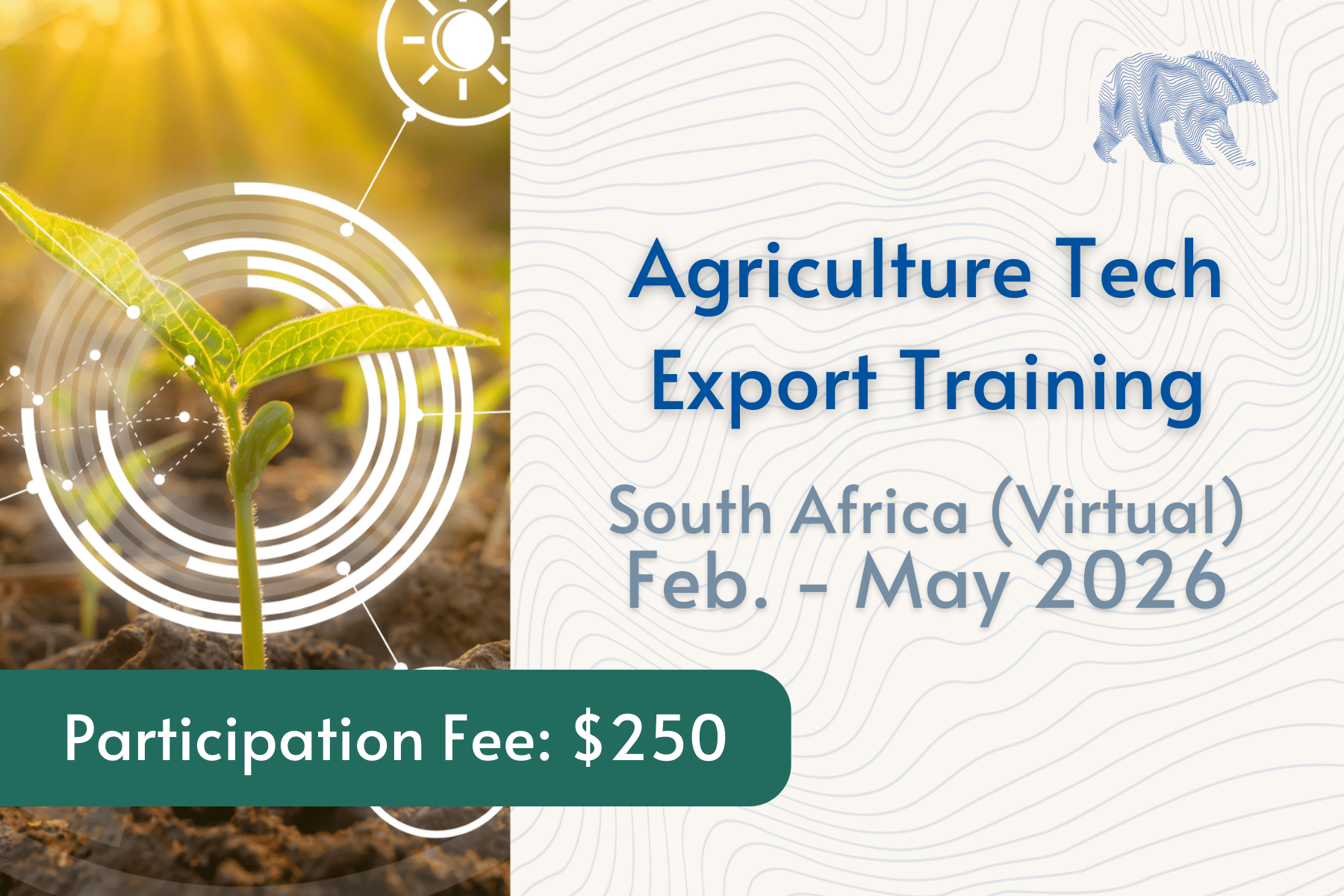
Agricultural Technology Export Training
OVERVIEW OF PROGRAM
In partnership with California Governor’s Office of Business and Economic Development, Zurcom International (an African-based trade facilitation and market entry specialist) is hosting a specialized Export Training Program designed exclusively for California-based agricultural technology (agtech) exporters. This series spans twelve sessions and provides an in-depth, practical guide to navigating export opportunities in South Africa and broader African markets. Participants will engage with experts, government officials, and industry leaders across trade, legal, logistics, standards, and market access stakeholders.
Additionally, participating firms will receive one-on-one coaching from market specialists. Following the successful completion of the program, participants will also receive virtual bespoke meetings with interested, qualified South African-based firms. These have a direct interest in the specific California-based agtech solutions.
WHY AGRITECH COMPANIES SHOULD PARTICIPATE
South Africa represents one of the most promising and dynamic frontiers for agtech expansion. With a well-established yet evolving agricultural sector, a growing digital transformation in farming, and supportive government policies, the country offers a compelling landscape for U.S. companies, particularly those based in California, to innovate, partner, and grow.
South Africa is Africa’s most advanced agricultural economy, contributing over 2.5% to national GDP and supporting millions of jobs. The country’s diverse climate and geography allow for the production of a wide range of crops, including:
- Cereals and grains: Maize and wheat are staple crops, with strong demand for yield-enhancing and climate-resilient technologies.
- High-value horticulture: Citrus fruits, grapes, avocados, and nuts (notably macadamias and pecans) are key export commodities.
- Vegetables and sugarcane: Major domestic consumption and export categories.
This diversity creates wide-ranging opportunities for smart irrigation, precision agriculture, pest control, drone-based crop monitoring, and data-driven decision-making tools.
The South African government has prioritized digital agriculture and innovation as part of its broader national development goals. Through the Agricultural and Agro-processing Master Plan (AAMP) and incentives under agencies like the Department of Science and Innovation and Technology Innovation Agency (TIA), agtech is seen as central to driving both food security and economic transformation.
South Africa’s agtech sector is still in a growth phase, making it an attractive market for early movers. There is a strong demand for localized innovations, particularly those tailored to smallholder farmers who make up a large portion of the agricultural workforce. Additionally, large commercial farms—many of which are export-oriented—are actively seeking cutting-edge solutions to boost productivity, sustainability, and climate resilience.
California agtech firms bring globally competitive expertise in precision farming, robotics, water-saving technologies, and AI-powered crop analytics—solutions that are increasingly sought after in South Africa due to rising concerns around drought, sustainability, and food supply chains.
Furthermore, South Africa can serve as a gateway to the broader region, connecting California companies to a market of over 300 million people.
Group Sessions
A comprehensive program covering all aspects of successful market entry into South Africa.
Session 1 – Understanding Africa & Entering South Africa (February 19, 2026)
Session 1: Africa: Trends in African Business in a Disrupted World Economy
Understand Africa’s economic landscape, growth opportunities, and key market sectors. Input from: Panel discussion with staff from five key regions of Africa.
Key Topics:
- Overview of Africa’s 1.5 billion consumer market
- Growing entrepreneurial middle class
- High-potential sectors including agricultural machinery
- Demographic potential and economic transformation
Session 2: South Africa: Country Market Building Market Knowledge
Comprehensive understanding of South Africa’s agricultural market and regulatory landscape. Input from: Market Entry Specialists
Key Topics:
- South Africa’s role in Southern Africa
- Agricultural base and market potential
- Southern African Customs Union (SACU), Southern African Development Community (SADC), and African Continental Free Trade Area (AfCFTA) context
- Food manufacturing opportunities
Session 3: South African Agricultural Market Overview
Comprehensive overview of South Africa’s agricultural sector. Input from: Agri-South Africa (South African Agricultural Industry Association).
Key Topics:
- Agricultural landscape overview
- Equipment demands and market trends
- Key industry players
- Role of agriculture in economy
Session 2 – Market Access, Legal Frameworks & Compliance (March 12, 2026)
Session 4: Agricultural Equipment Market Dynamics
Understanding demand for agricultural machinery and distribution channels. Input from: South African Agricultural Machinery Association (SAAMA)
Key Topics:
- Agricultural machinery sector overview
- Growth opportunities
- Demand drivers
- Market entry best practices
Session 5: Legal Considerations for U.S. Exporters (Patents, Trademarks and Intellectual Property)
Learn about legal aspects of exporting agricultural equipment, and understand IP protection in the South African market. Input from: Leading Law Firm
Key Topics:
- Key legal considerations
- Contract analysis
- Legal frameworks
- Dispute resolution
- IP law requirements
Session 6: Broad-Based Black Economic Empowerment (BBBEE)
Understand BBBEE policies and their impact on U.S. exporters. Input from: BBBEE consultant.
Key Topics:
- BBBEE overview and impact
- Compliance requirements
- Benefits for U.S. exporters
- Integration strategies
Session 3 – Quality, Logistics & Financial Support (April 9, 2026)
Session 7: South African Bureau of Standards (SABS)
Understanding regulatory and quality standards for agricultural equipment. Input from: SABS Representatives
Key Topics:
- Certification process
- Safety and compliance standards
- Navigation of certification
- Local standards importance
Session 8: Logistics: Getting Agricultural Equipment to South Africa
Practical insights into shipping and logistics. Input from: California and South African logistics firms.
Key Topics:
- Shipping strategies
- Ports and customs navigation
- Transportation routes
- Local logistics partnerships
Session 9: Trade Finance / U.S. Government Support for Exporters
Learn about government programs and support for exporters, including trade incentives and funding. Input from: U.S. Department of Commerce and Ex-Im Bank of the USA
Key Topics:
- Trade Policies and Incentives
- Support for Agricultural Technology
- Export Finance
- Tariffs
Session 4 – Business Culture, Local Partnerships & Program Wrap-Up (May 7, 2026)
Session 10: Panel Discussion with South African Equipment Companies
Insights from local agricultural equipment distributors. Input from: South African Agricultural Equipment Company Representatives
Key Topics:
- Market challenges and opportunities
- Buyer preferences
- Market positioning
- Building distributor relationships
Session 11: Cultural Understanding of South African Markets
Develop effective pitching strategies for South African market. Input from: Zurcom International Team
Key Topics:
- Sales pitch structuring
- Cultural considerations
- Role-playing sessions
- Tailored recommendations
Session 12: Final Q&A and Program Wrap-Up
Program conclusion and next steps. Input from: Program Manager and Key Staff Panelists
Key Topics:
- Final questions and clarifications
- Key takeaways review
- Resource provision
- Action planning
One-on-One Coaching
Our coaching sessions are tailored to your specific business needs and export goals.
- Product-Specific Market Assessment
Detailed analysis of market potential for your specific products - Export Readiness Evaluation
Assessment of your company’s preparedness and action plan development - Buyer Identification
Targeted identification of potential buyers for your products - Marketing Materials Review
Review and optimization of your marketing materials for the South African market
Virtual Buyer Meetings
Connect directly with pre-qualified South African buyers interested in your products.
Pre-Qualified Buyers
We identify and pre-qualify potential buyers who have expressed interest in California agricultural products and technologies.
- Major South African retailers
- Distributors and wholesalers
- Food processors and manufacturers
- Agricultural input suppliers
Virtual Meeting Format
We facilitate and moderate virtual meetings to ensure productive discussions and potential business development.
- Introduction and company overview
- Product presentation
- Q&A and discussion
- Follow-up action planning
WORKING WITH ZURCOM INTERNATIONAL
Zurcom International offers key sales contacts and exclusive information in new global markets in Africa, the Caribbean and around the world. Our team is one of the world’s most experienced in trade facilitation and a leader in assisting firms entering the African, Caribbean and global marketplaces.
Zurcom has a long, successful record of working with companies toward their international sales goals in Africa. Our team has a wealth of experience working with companies directly and through governmental trade agencies toward successful company export sales. Since 1999, Zurcom has completed over 4,300 company projects, as well as over 160 governmental trade missions composed of company delegates.
Zurcom assists firms entering the market through direct representation. Firms wishing to expand their presence in Africa or globally work through us, from company registration to direct sales representation for results-based outcomes.
For more information, please contact Richard Zurba.
Apply for this training HERE.
Download the flyer for more information.


